
Modern diagnostics involves medical imaging, which allows clinicians to treat, monitor, and detect disease more precisely. In radiology departments, distributed teleradiology workflows, and any other application that requires the efficient access and interpretation of imaging data, the DICOM viewer is a vital ingredient.
As healthcare systems keep moving towards cloud-based and distributed infrastructures, the question organizations increasingly have to face is:
Is it better to use an open-source DICOM viewer or to buy a commercial one?
This choice stretches much beyond cost. It directly affects clinical reliability, regulatory compliance, system performance, integration capabilities, and long-term operational risk. Making the wrong decision may result in inefficiencies, a security gap, and scalability.
This guide will present an open-source and commercial DICOM viewer comparison in a comprehensive and real-life way to assist healthcare organizations in making a smart and future-proof decision.
When deciding between open-source and commercial DICOM viewers, there is a trade-off between flexibility, cost, and clinical risk. The most important lessons are:
• Open-source Viewing Software Is Customizable And Has No Clinical Compliance Or Support.
• Commercial Viewers Offer Credibility, Unification And Regulative Conformity.
• Unobtrusive Costs In An Open-source Solution Can Easily Supersede The Savings Made In The Beginning.
• Using Cloud-based Views Is Becoming The Norm.
• Security, Scalability, Andhealthcare Interoperabilityshould Be Prioritized In Decision-making Instead Of Focusing On Cost.healthcare interoperability
The main difference between open-source and commercial DICOM viewers is in the control, responsibility, and risk distribution.
The open-source DICOM viewers make the underlying source code fully available and enable organizations to tailor the features, workflows, and integrations to their unique requirements. This flexibility renders them desirable to development environments and research institutions. This however implies that the organization takes full responsibility of maintenance, security, compliance, and optimization of performance.
DICOM commercial viewers, in their turn, are complete solutions that are operated in clinics. They are pre-compliant, vendor-supported and optimized. Healthcare organizations no longer need to worry about managing infrastructure and developing it; they should concentrate on clinical operations and leave system reliability and updates to the vendor.
In reality, the choice is not really between free and paid; it is between control and accountability.
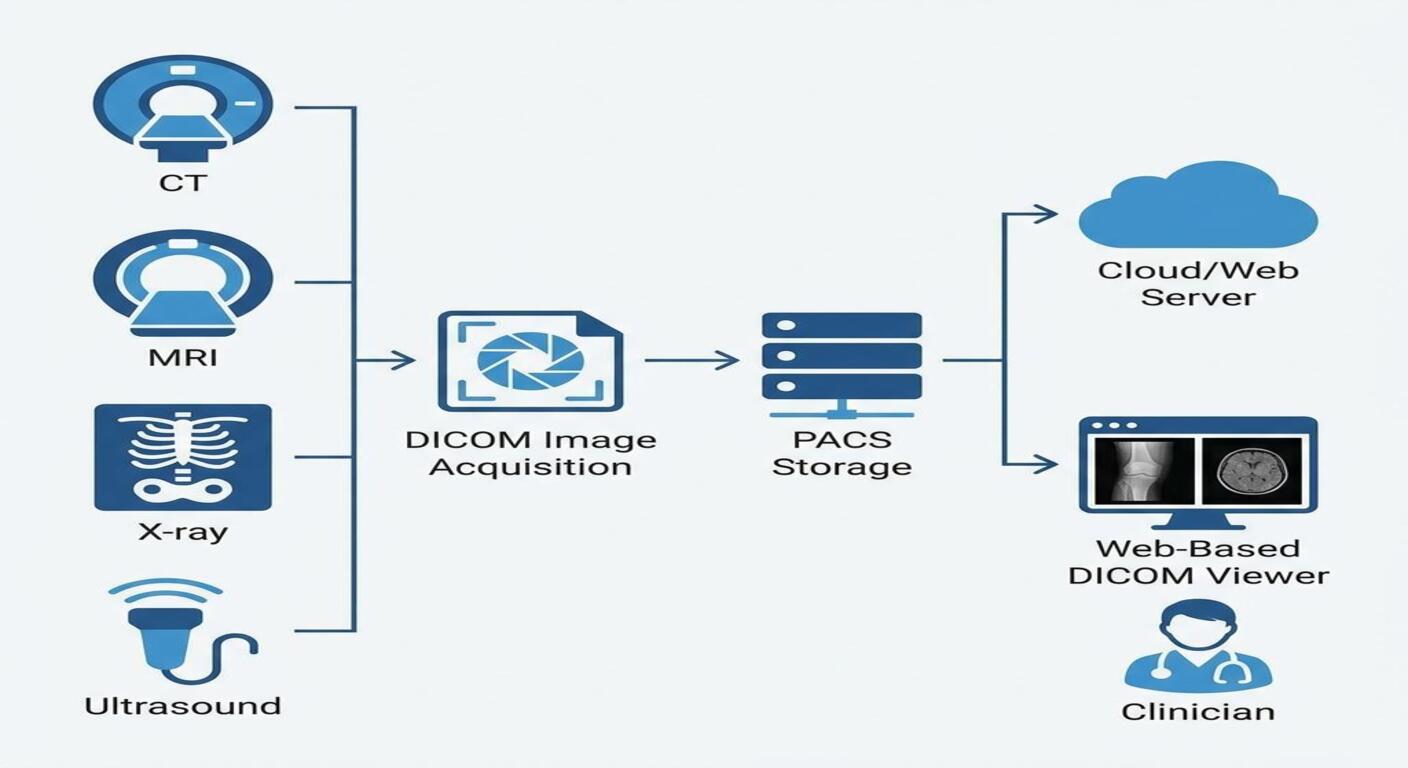
A DICOM viewer is a computer program that allows visualization and analysis of medical imaging data that follows the Digital Imaging and Communications in Medicine (DICOM) format. These pictures contain CT scans, MRIs, X-rays and ultrasound studies.
DICOM viewers are the main interface of interaction of radiologists and clinicians with imaging data in clinical workflows. They enable users to change image contrasts, measure results, label findings, and compare research across time.
In addition to visualization, the current DICOM viewers are quite important in facilitating communication between departments and geographic areas. With the increased distributed nature of healthcare delivery, the possibility of accessing images in a secure way everywhere has become critical.
This is the reason why the transformation of the desktop-based viewers to the web-based and cloud-native is transforming the medical imaging workflow.
In order to get a clear picture of the open-source vs commercial debate, one should take into account the way DICOM viewers are implemented.
Traditional web-based viewers are installed locally in individual desktops in hospitals or imaging stations. Although these systems are reliable, they are not so scalable and can be accessed remotely. They work best in a single-location setting that has a stable infrastructure.
Zero-footprint viewers, which are web-based, are an important development. These viewers have a web browser which means that they are not installed at all. Imaging studies can be accessed by clinicians virtually at any device, and they are the best fit in remote diagnostics and collaboration.
Cloud-native DICOM viewers take this a step further by integrating directly with cloud PACS systems. They are scalable, highly available and distributed workflow solutions that enable healthcare organizations to handle the imaging data at multiple sites without disruptions.
In North America the industry is moving quickly to web-based and multi-site healthcare networks with cloud-based and web-based viewing environments.
Open-source DICOM viewers are computer programs that can be modified and developed by software developers since they can access their source code.
Popular ones are OHIF Viewer, a common web-based open source platform, and Weasis, a desktop-based viewer commonly used in research.
Cost efficiency at the first stage is one of the main benefits of the open-source viewers. They may also be a good alternative to organizations operating on lean budgets because they have no licensing fees. But the thing is in customization. Development teams are able to customize workflows, third-party integration and create specialty imaging apps.
Although there are these advantages, open-source solutions have serious limitations in clinical settings. The majority of them are not regulatory compliant and, therefore, can be out of compliance (like the standards of HIPAA or PIPEDA). Also, companies are required to handle their updates, their security patches, and infrastructure on their own.
This is why open-source DICOM viewers are most applicable in research institutes, academic settings, and development groups, as opposed to clinical care management.
Commercial DICOM viewers are business level applications made to be used by clinicians. They are constructed on the basis of compliance, performance and integration.
Regulatory compliance is one of their greatest benefits. Such systems are aimed at satisfying high health care standards and make sure that the patient information is treated safely and legally. This involves adherence to the HIPAA in the United States and PIPEDA in Canada in North America.
Commercial viewers also offer advanced imaging capabilities such as 3D reconstruction, multi-planar reconstruction, and, in some cases, AI-assisted analysis. These features are critical for accurate diagnosis and efficient workflows.
Integration is another key strength. Commercial solutions are designed to connect seamlessly with PACS, RIS, and EHR systems, often using standards such as HL7, FHIR, and DICOMweb. This guarantees that there is a smooth flow of imaging data throughout the health care ecosystem.
Commercially speaking, commercial viewers are also optimized to process large imaging datasets. The ability to stream images and WebGL acceleration enable clinicians to work with images instantly without delays.
In the case of hospitals, clinics and teleradiology providers, these benefits make commercial viewers the choice.
Comparing between open source and commercial DICOM viewers, one must not only look at the initial cost, but also the overall cost of ownership and operational effect.
Open-source solutions can seem cheap initially, however, they can be costly to develop, maintain, and operate. Integration with the existing systems can be complicated, and compliance may need more tools and processes.
| Feature | Open Source DICOM Viewer | Commercial DICOM Viewer |
| Initial Cost | Low (free to use) | Subscription or license-based |
| Total Cost (TCO) | High (hidden development and maintenance costs) | Predictable and structured |
| Compliance | Not guaranteed | HIPAA, PIPEDA, GDPR compliant |
| Integration | Requires custom development | Built-in PACS, RIS, and EHR integration |
| Performance | Variable depending on setup | Optimized for clinical workloads |
| Support | Community-based support | Vendor-backed support with SLAs |
| Scalability | Limited | High (cloud-ready and enterprise scalable) |
| Security | Depends on configuration | Enterprise-grade security and monitoring |
 - Presented by PostDICOM.jpg)
Commercial solutions are predictable in cost, their upfront costs are lower, and they have less operational burden. The inbuilt support, security and compliance allow organizations to escape numerous under-the-hood issues with open-source deployments.
Finally, it is up to the priorities of the organization. In the case of clinical settings, the importance of reliability and risk management usually prevails over customization.
One factor that has not received much attention during this decision is risk.
With open-source viewers, compliance risk is a major concern. Lack of adherence to healthcare regulations may lead to legal fines and tarnishing of reputation. There is also an increased security risk in case systems are not configured and maintained properly. Also, the absence of vendor support may result in operational breakdowns in case of problems.
Business watchers would not be risk-free, but they tend to be less risky. It may be hard to change vendors because of vendor lock-in, and long-term costs may be higher in the long run. These risks are however usually counterbalanced by the advantage of stability, support and compliance.
To the majority of healthcare organizations, risk reduction is a more important priority than cost reduction.
The greatest differences between the two techniques are in their technical architecture.
Open-source viewers may make use of local rendering or partially optimized web rendering. They can not have high-end streaming options and need to be configured manually. Although flexible, these systems may fail with performance on large datasets.
Conversely, cloud-based modern commercial viewers are developed using sophisticated architectures based on DICOMweb standards of WADO-RS, QIDO-RS and STOW-RS. Such APIs facilitate the querying, retrieving and storing of imaging data.
 - Presented by PostDICOM.jpg)
A second major difference is streaming-based rendering. Commercial viewers do not load image studies as a whole but only the required part of an image, which saves a lot of bandwidth and improves the performance.
WebGL acceleration also improves the performance by allowing the use of the GPU to do renderings in the browser. This enables clinicians to engage with complicated imaging information without difficulty even on conventional equipment.
Together with cloud infrastructure, these technologies allow real-time access, scalability, and work with the whole world.
The best option will be dependent on your case of usage and organizational requirements.
An open-source viewer can give you the flexibility needed, especially when you are a research institution, or a development team with a high level of technical resources. It can be customized and experimented with without being expensive initially.
But, when you are dealing in a clinical setting, a commercial solution can almost always be the superior choice. Hospitals, clinics and teleradiology facilities need reliable, compliant systems that can be easily integrated with the existing infrastructure.
In the context of organizations that need to handle numerous sites or huge imaging data, commercial viewers in clouds provide the optimal balance of scalability, performance, and accessibility.
| Use Case | Recommended Option | Reason |
| Research lab | Open Source | High customization with minimal compliance requirements |
| Startup with the development team | Open Source (early stage) | Flexibility and cost control during the development phase |
| Small clinic | Commercial | Ensures compliance, reliability, and ease of use |
| Hospital system | Commercial | Requires integration, scalability, and regulatory compliance |
| Teleradiology provider | Cloud-based commercial | Enables remote access and real-time collaboration |
| Multi-location healthcare group | Cloud-native commercial | Centralized access, scalability, and performance optimization |
 - Presented by PostDICOM.jpg)
The healthcare industry is taking a radical turn towards distributed and digital care models. Remote diagnostics, telemedicine and collaboration over a distance are emerging as a norm.
Cloud-based DICOM viewers are in a unique position to enable this transformation. They allow clinicians to access imaging data safely anywhere, make critical decisions more quickly, and provide better patient outcomes.
Such systems also eliminate the requirement of on-premise infrastructure, which reduces IT overhead, and makes implementation easier. The scalability of cloud solutions becomes more significant as the imaging volumes keep expanding.
That is why cloud-native platforms nowadays are getting highly popular among contemporary healthcare institutions.
No, in most instances, the open-source viewers are not regulatory compliant and are not suited in a non-clinical facility.
Popular ones are OHIF Viewer and Weasis. These tools are commonly applied in the research and development processes.
Yes. In the case of healthcare organizations, compliance, performance, and support are more beneficial than the initial cost.
Yes, but integration may need technical knowledge and development.
A zero-footprint viewer is a web-based application that operates not in a browser.
They facilitate remote access, scalability, and real-time collaboration, which is why they are perfect in the context of contemporary healthcare processes.
Medical images are viewed and analyzed using a DICOM viewer, and stored, managed, and distributed into the healthcare systems using a PACS (Picture Archiving and Communication System).
The use of desktop viewers does not usually involve the use of the internet, whereas web-based and cloud DICOM viewers use secure internet connections to allow access and collaboration remotely.
Yes. Contemporary web-based DICOM viewers are also mobile and tablet-friendly, enabling clinicians to find imaging data safely in portable devices.
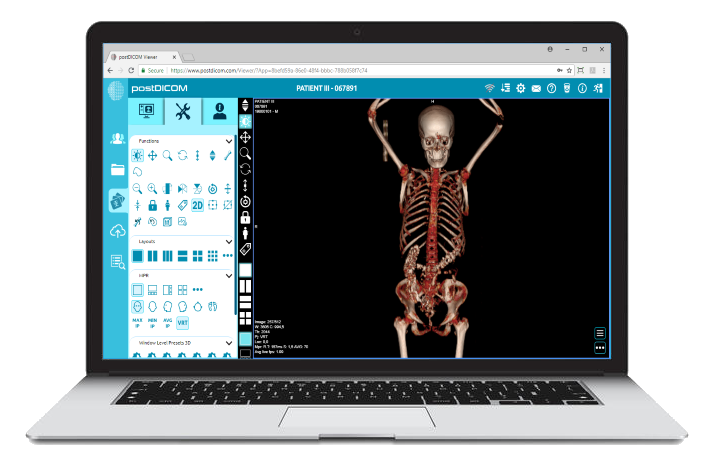
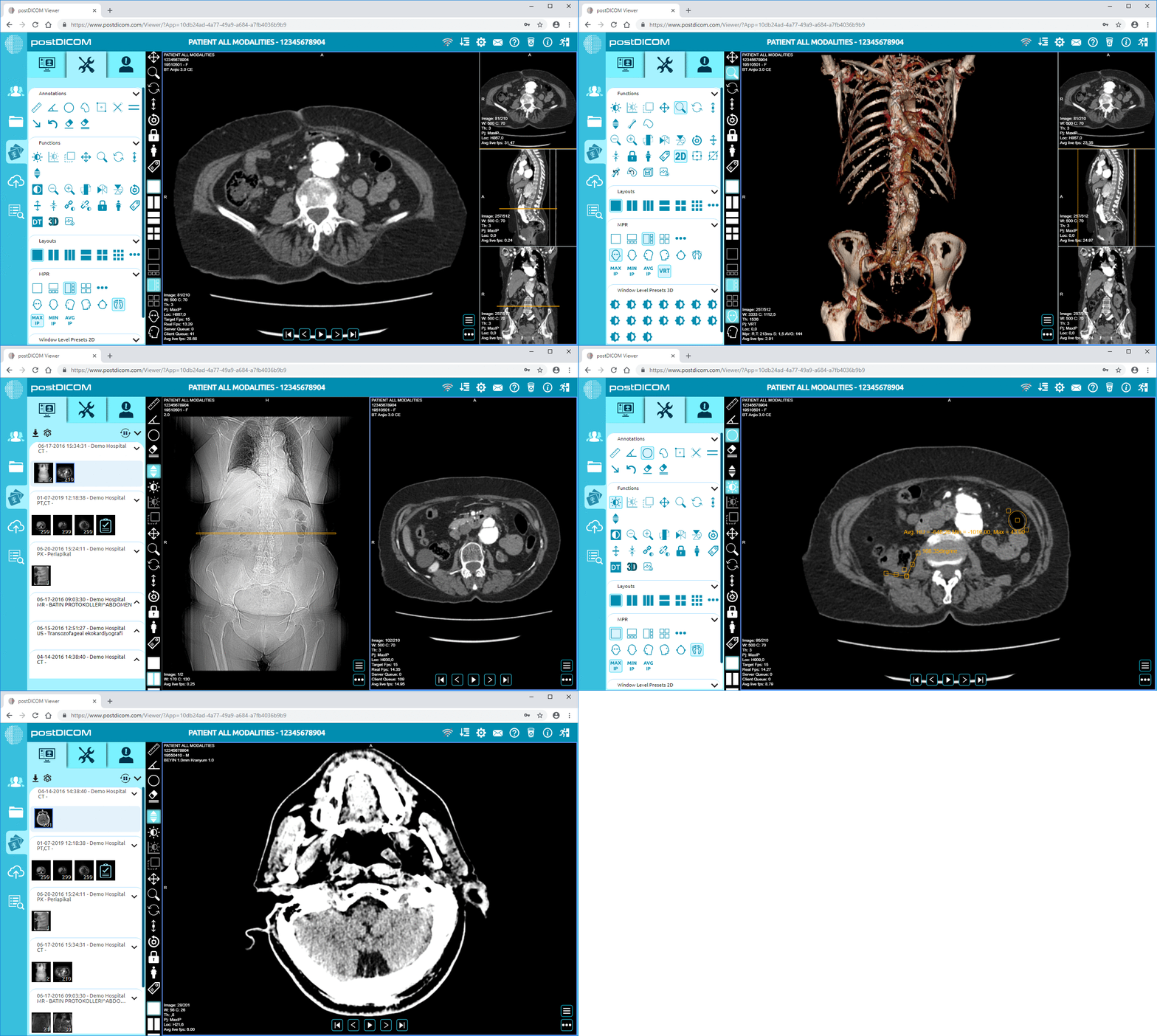
|
Cloud PACS and Online DICOM ViewerUpload DICOM images and clinical documents to PostDICOM servers. Store, view, collaborate, and share your medical imaging files. |

